
What 'World-Class' Actually Means
The lengths best brands go to, even when nobody's looking.
Apple has a room dedicated to testing the opening of a box. The air resistance of the lid against the base — the speed of separation, refined over months — produces a moment of anticipation with no functional purpose. The device inside performs identically without it. That room is one of the more precise definitions of world-class I've encountered.
The phrase itself has been in agency decks and pitch meetings long enough to carry almost no information — a signal of ambition, rarely a description of anything specific. The concept underneath the performance is specific and real, which is what makes it worth examining.
World-class has an actual meaning: your work, measured against the best anywhere, holds up. The comparison is global and unforgiving. Most organisations that claim the term would not survive it, and most of them know it — which is partly why they prefer the claim to the standard.
This piece was originally published in PX PUSH's Journal: What 'World-Class' Actually Means.
I've spent years working in branding and design, running studios, building brands, and judging work for Awwwards. The phrase comes at you constantly in this industry, usually as shorthand for ambition rather than a description of anything specific. This is an attempt to say what it actually means.
The Gap the Market Rewards
Interbrand measures what they call the Role of Brand Index — the degree to which a brand influences a purchase decision independently of price or convenience. Their research suggests a one-percent improvement in that score correlates with a 2.3-percent increase in share price. The numbers frame something more basic: customers pay a premium for organisations they trust to be the same thing everywhere.
That trust is built in the invisible moments — the automated confirmation email sent from a no-reply address, the onboarding flow designed for a user who already understands the product. No team was briefed on any of these, and none of it will appear in a case study. They accumulate, and they are where the brand either holds or begins to slip.
Brian Chesky's 7-star exercise captures why most organisations fall short. He asks what a 7-star Airbnb stay would actually look like. The 5-star baseline is standard: the host lets you in, the house matches the listing, everything works. At seven stars, the host picks you up from the airport, stocks your preferred snacks, has already booked the surfboard lesson because they read your profile. Most of it can't be systematised. The point is to find the floor of ambition and work back from something higher. Most organisations never do this — accepting a five-star standard because it's what the market verifies, and rewarding accordingly.
Systems, Constraints, Instinct
Generic brands rely on aesthetics. World-class brands rely on systems — the constraints that let an organisation hold its identity at scale, when the founders are unavailable and the team has grown beyond anyone's ability to supervise.
The practical test: can a new hire look at the brand system and produce something unmistakably on-brand, without a senior sign-off on every decision? The brands that pass it are almost always operating under the strictest internal rules — rules that have been in place long enough to stop feeling like rules.
Disney calls its staff Cast Members and its customers Guests, which is a daily operational reminder that every person in the organisation is in a performance with a defined standard. The Ritz-Carlton runs this logic further: each employee carries a laminated card with the Credo and twelve service values, and every morning, in properties around the world, one of those values is drilled in a fifteen-minute line-up before anyone meets a guest.
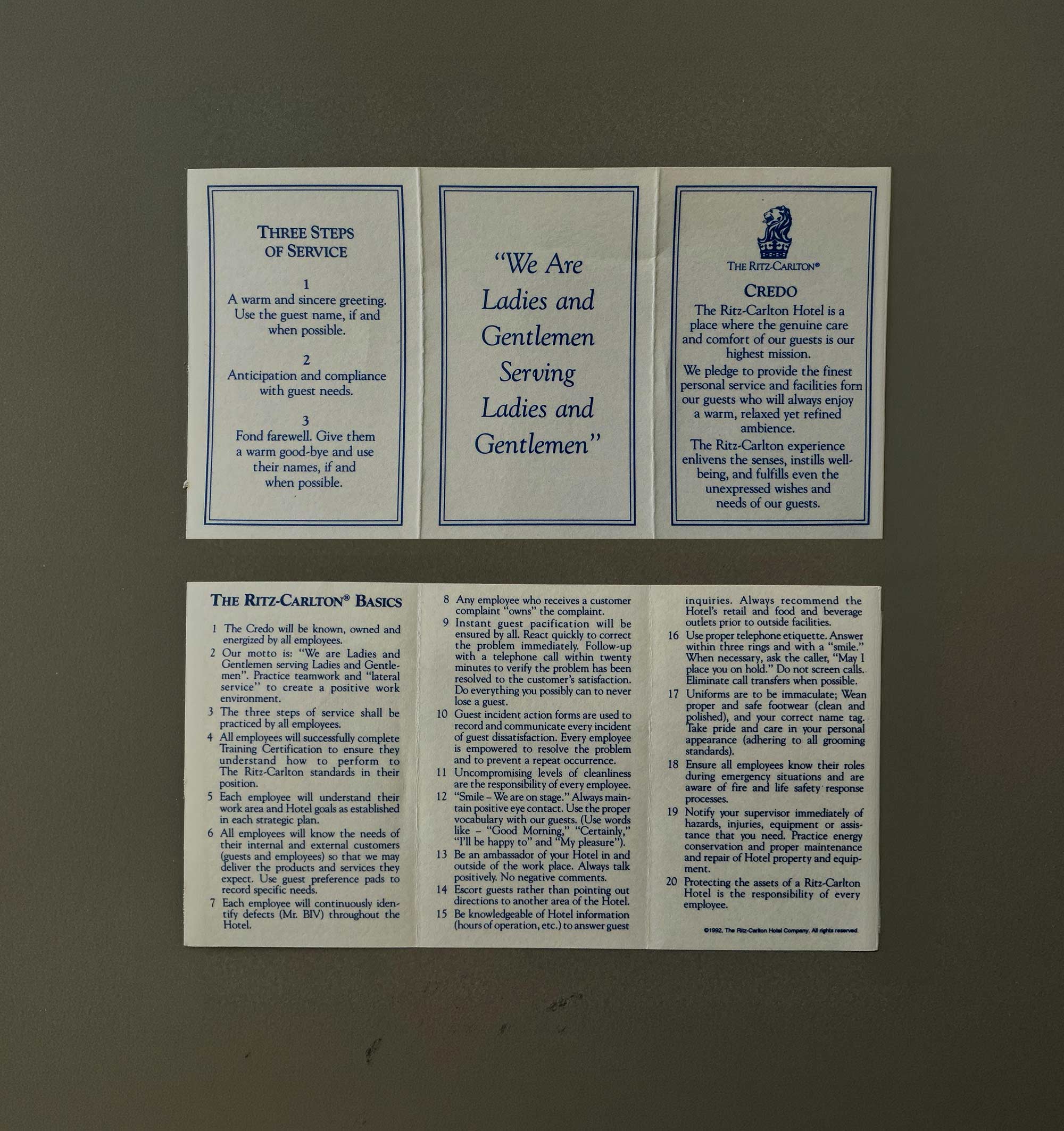
The Ritz-Carlton Credo Card, carried by every employee — a physical artifact that encodes the Gold Standards into daily service behaviour.
Apple's approach is different in kind — the advertising stripped to short sentences in the present tense, the product foregrounded above everything — but the underlying mechanism is the same: a constraint old enough to have become instinct. Thousands of people inside the same framework, over decades, produce a coherence that feels genuine rather than managed. The constraint eventually stops being felt as constraint at all.
The Discipline Underneath
Jony Ive held that people may not be able to articulate why they like a product, but they sense care. That sensing — the felt quality of an encounter with an object or a brand — is the residue of decisions made the harder way when the easier way was available. Apple's box-opening room is one extreme expression of this. The decisions that compound into a world-class identity are mostly more ordinary: the error message someone chose to rewrite, the onboarding rebuilt after watching users fail at the old version.

Sir Jony Ive, Apple's Chief Design Officer from 1996 to 2019. His argument: that users sense care without being able to name it — and that the obligation to care extends to the parts of a product nobody will ever see. Photograph © Paul Harris / Getty
The same logic ran into the hardware itself. At the 1998 launch of the original iMac, Jobs told the audience: "The back of this thing looks better than the front of the other guys, by the way." The internal components were designed with the same care — not for the engineers who might service the device, but because the standard didn't have an exception clause for parts no one would ever see. Apple weren't just doing this privately. They were publicly proud of it, which tells you something about the culture that produced it.

The internal components of an Apple MacBook — organised, finished, and considered even though no user will ever see them. The standard applied to what's visible and what isn't is the same.
Bernard Arnault built the world's largest luxury group on a long-term version of the same discipline. Decisions across LVMH are made in decades rather than quarters. Artistic integrity is non-negotiable even when the short-term arithmetic favours compromise. The heritage of the brands is the actual competitive advantage — which makes protecting it the actual work, and not adjacent to it.
What Gets Refused
World-class is what a brand becomes when it refuses to separate the things the market rewards it for separating: the product experience from what the marketing promises, and the visible touchpoints from the ones nobody photographs.
Those separations are efficient. They reduce cost and simplify accountability, and they produce results that look acceptable over a short period. Most organisations make them, because the short-term arithmetic is real. The long-term arithmetic is different.
Tesla built a global charging network when EV infrastructure barely existed — absorbing a problem every other manufacturer delegated to governments and third parties. The charging network is the ownership experience. Closing that gap required treating someone else's problem as your own and building accordingly.

A Tesla Supercharger station. Built before the market demanded it — the network is not adjacent to the Tesla ownership experience. It is the ownership experience.
When a customer encounters a broken link or an invoice generated from a template nobody updated, they don't register a bug in isolation. They begin — without necessarily putting it into words — to wonder what else has been left unfinished. Detail is proof that someone cared enough to finish the back of the cabinet, even when it faces the wall. Treating every friction point this way means that closing one reveals the next.
What Accumulates
Stefan Sagmeister's argument is that beauty is a functional requirement: beautiful things tend to be taken care of. The quality that people sense in a brand or an object — without being able to say exactly why — is the slow accumulation of decisions made on purpose in the places where shortcuts were available and would have gone unnoticed.
These decisions compound. Thousands of people inside the same framework, over years, produce an identity that eventually feels genuinely coherent — coherent in a way that can't be reverse-engineered by a brand consultancy, because it lives in the organisation's daily behaviour rather than in any document. The rules become instinct, and instinct shapes every decision made in every room the founders will never enter.
World-class is what remains when everything that could have been compromised has been refused. Customers feel this without quite naming it — a sense that something has been finished, that nobody settled for probably fine. Building it requires no single dramatic commitment. Only the consistent refusal of a thousand small ones.
Sources
- Apple's Secret Packaging Design and Testing Room Revealed. SlashGear
- iMac Introduction, 1998. allaboutstevejobs.com
- How Brand Impacts Share Price. Interbrand
- Role of Brand Report 2026. Interbrand
- Reid Hoffman, How to Scale a Magical Experience: 4 Lessons from Airbnb's Brian Chesky. Medium
- Foundations of Our Brand. Ritz-Carlton Leadership Center
- Ritz-Carlton Practices for Building a World-Class Service Culture. NIST
- Customer Service Lessons from Disney. Propeller Digital
- Jony Ive says we 'sense care' in good design. 9to5Mac
- What Leadership Style is Bernard Arnault? Quarterdeck
- Stefan Sagmeister on Beauty as Function. reSITE
- Tesla Supercharger — Wikipedia