August Weber: The Man They Almost Erased
A German banker who stood against the Reich. Part 1.
In the spring of 1940, as Germany prepared its invasion of Britain, a small team of SS officers compiled a list. Its formal title was Sonderfahndungsliste G.B. — the Special Search List, Great Britain, known to history as the Black Book. The intention was precise: if the invasion succeeded, these were the people to be found and arrested first. Not soldiers or government ministers, but writers, intellectuals, journalists, and political figures the Reich considered dangerous enough to hunt down personally.

Sonderfahndungsliste G.B. (Hitler's Black Book), 1940.
Entry W32 reads:
August Karl Wilhelm Weber. Born: 4 February 1871, Oldenburg. Occupation: Bank Director. Believed location: London. Wanted by: Amtsgruppe IVA1b — Reactionaries, Pacifists, Defeatism, Anti-Nazi Activity.
He shared the list with H.G. Wells, Bertrand Russell, Sigmund Freud, Noel Coward, and Winston Churchill.
He was my great-grandfather.
The person who wrote about August Weber at most length was his son, my grandfather Jan Webber — first in a 1997 essay, then in memoirs he wrote in his last years, which my uncle Jonathan Webber illustrated and published in Berlin in 2025. Jan died in London in 2009. Most of the people who knew August have gone too. Beyond the family's own accounts there is a Wikipedia page in German, a few archive entries, a reference in a Reichstag commemorative book, and a scanned entry in a Nazi denaturalisation registry. This is an attempt to add something more.
Origins
August Weber was born in 1871 in Oldenburg, in the north of Germany, the middle child of nine. His father, Karl Friedrich Anton Weber, was the first of his line to leave crafts and farming behind. He managed the local savings bank, coaxed farmers into moving their money out of stockings and mattresses, introduced cheques, and sat on the Oldenburg town council for many years. The roots beneath him went back to 1490 — to small farmers, tailors, a wheelwright, and goldsmiths who made church silver. Not nobility, not old money.
His grandmother on his mother's side ran the family farm at Bümmerstede alone for thirty years after her husband died, and the Grand Duke of Oldenburg — who had a reputation for being unpretentious — would occasionally ride past. When he did, she invited him in for a glass of milk. August told that story often. It seemed to represent something he valued: the idea that one person is not inherently owed deference by another.
He studied law in Berlin, Marburg, and Jena, and earned a doctorate in 1895. He did his compulsory military service — his regimental commander was Hindenburg — and declined to become a reserve officer afterward. He saw no reason to continue once the obligation was met.
He joined the Dresdner Bank as a correspondent in 1896, rose to Prokurist, then moved to run a provincial bank in Löbau, in Saxony, in 1900. In 1913 he moved to Berlin as a managing director of the Mitteldeutsche Kreditbank. Over the following two decades he would become a significant figure in Weimar Germany's financial and industrial life: deputy chairman of the Commerzbank, board member of the Reichsverband der Deutschen Industrie, president of the Jute Industry Association, member of the Berlin Chamber of Commerce. He knew Robert Bosch. He counted the painter Max Liebermann among his friends — Liebermann, whose subjects included Albert Einstein, Gerhart Hauptmann, and Paul von Hindenburg, painted August's portrait in 1927, at the height of his influence.
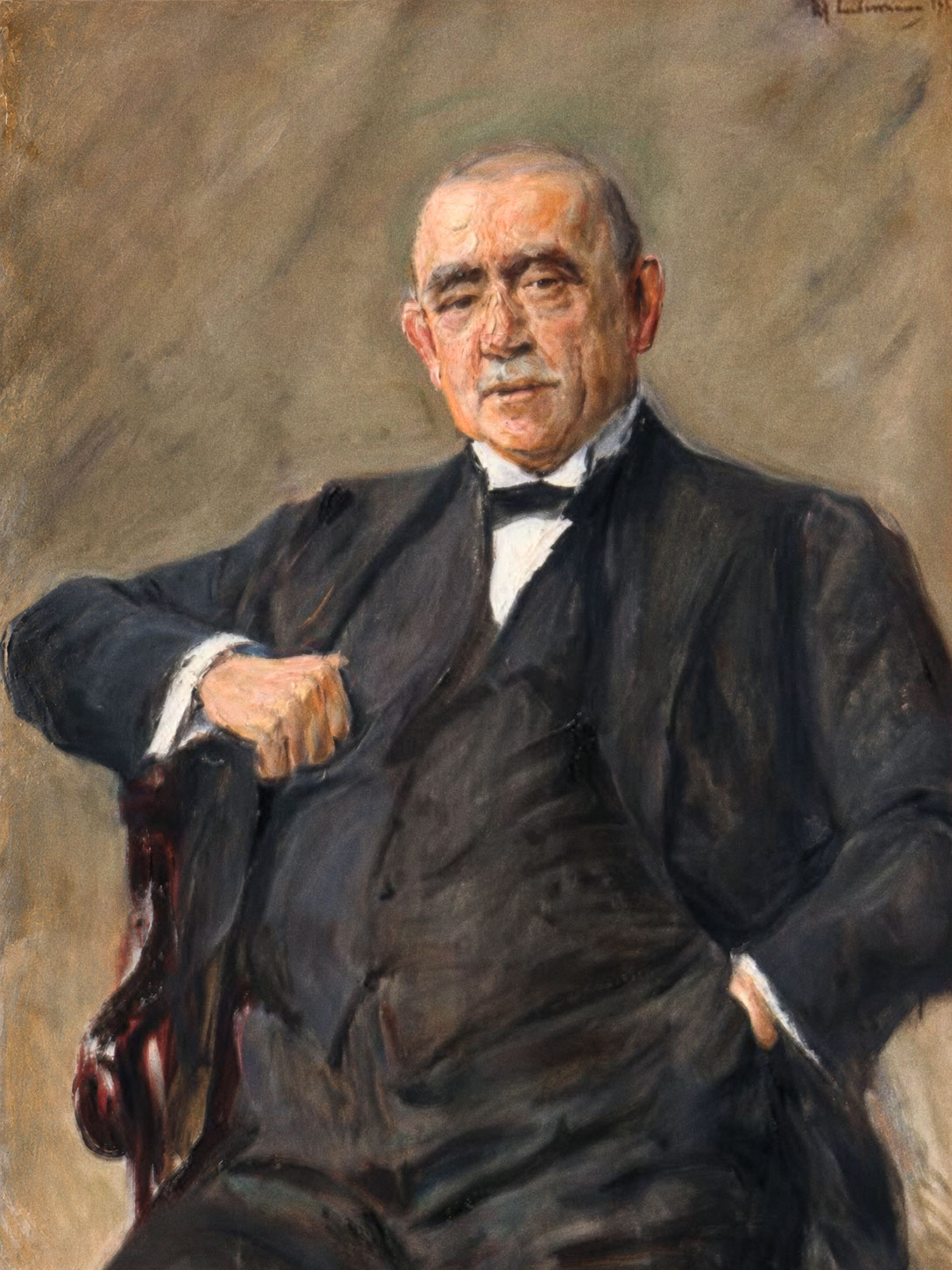
Portrait of August Weber by Max Liebermann, 1927. Oil on canvas. Private collection, Weber family.
In July 1914, shortly before the start of the First World War, he married Marie Meyer-Cohn. She came from one of Berlin's most established Jewish banking families: her grandfather, Meyer Cohn, had founded a private bank Unter den Linden with clientele that included Empress Friedrich. The marriage was unusual for the time and met resistance from both sides. Her family initially considered August too provincial; his family had reservations about the religious difference. The marriage lasted over forty years, until his death.
During WWI he worked in the war economy, organising raw material supply for the textile and paper industries and overseeing meat provision for the Prussian and Saxon armies. The government offered him the title of Geheimer Oberregierungsrat — a senior state honour. He turned it down. When his son Jan later asked why, August explained: he had no use for titles in general, and his earned doctorate was sufficient. More practically, he said, if you hold a title and give a political speech, you hand your opponents a weapon. You liar, you pig, you Geheimer Regierungsrat. "That sort of thing is a gift to political enemies."
Political Life
August entered politics as a National Liberal member of the Reichstag in 1907, elected for Löbau. He was returned in the same election that first brought Gustav Stresemann to parliament; the two knew each other well. He made his name there on finance, as the principal author of legislation regulating the Berlin Stock Exchange. In 1912, expecting to lose the seat to the Social Democrat candidate, he didn't stand again. He returned to political life after the war, helping found the Deutsche Demokratische Partei (DDP) in December 1918 — a liberal, pro-democratic party — rather than follow the National Liberal mainstream into more conservative territory.
He didn't stand for election again at first, occupied with business: the DDP, the Weimar economic institutions, the industrial boards. He was offered the post of Reichswirtschaftsminister — Economics Minister — three times during the Weimar period and declined each time, on financial grounds. He could not afford to leave private work, and he had no interest in an office that came with obligations he couldn't meet honestly.
By 1920 he had leased the Domäne Löpten, an estate south of Berlin, where he raised his family. The house had been built as a hunting lodge for the Kaiser, who visited it once. The surrounding village was in a state Jan later described as medieval — earthen floors, no stoves, no sanitation. August had sixteen workers' houses built, brought electricity to the village, lobbied the government to build a road. A street there still bears his name today: Weberweg.
As the 1920s ended, the National Socialist movement's growth alarmed him enough to return to active politics. He stood again for the Reichstag in 1928, in Breslau, and lost. He was elected in 1930 when the DDP merged into the Deutsche Staatspartei, and served as the faction's parliamentary leader from 1930 to 1932, representing the Potsdam constituency.

Deutsche Staatspartei parliamentary portraits, c. 1930 — August Weber listed as Dr. Weber (Potsdam), bottom right
The Warning
On 24 February 1932 — nearly a year before Hitler came to power — August gave a speech in the Reichstag that caused a public sensation. Standing as faction leader for the Staatspartei, he accused the National Socialist Party directly of political murder. He drew on the research of the statistician Emil Julius Gumbel, who had documented in precise figures the disparity in how German courts sentenced right-wing versus left-wing political killers. When Gregor Strasser shouted him down, August promised proof. Two days later, on 26 February, he laid his papers on the table and went further than statistics. He named a specific case, established by a German court: the 1920 murder of a rural labourer falsely accused of betraying a weapons transport, shot twice in the face at point-blank range. The man who killed him was, at the time of the speech, a sitting member of the Nazi parliamentary delegation. Then he read the party's own words back to the chamber — from storm-trooper songs, from speeches by Goebbels and others, from the instructions issued to the SA.
He had direct personal confrontations during Reichstag sessions with Goebbels, Frick, and Gregor Strasser. It was not the kind of opposition that could be forgotten or filed away. It was specific, documented, and delivered in public on record.
He was sixty-one years old.

The plenary chamber of the Reichstag, Berlin, c. 1930. In February 1932, August Weber stood here as faction leader of the Deutsche Staatspartei and accused the National Socialist Party directly of political murder. Bundesarchiv, Bild 102-09036 / CC BY-SA 3.0
Under the Third Reich
Hitler came to power on 30 January 1933. At the beginning of April, August was arrested in his Berlin office on the orders of the Nazi Gauleiter of Saxony, Martin Mutschmann — for reasons, August later wrote, that he never learned. That night he was driven to a concentration camp in Saxony and the next day moved to the prison at Zittau, where the SA left him for ten days in total darkness. The pretext was that, as a representative of the Commerzbank, he had ruined a Saxon company and pocketed two million Dutch guilders. A Berlin newspaper ran the headline: Embezzlement of 5 Million Marks. August Weber Arrested. It was a fabrication. His lawyer had the case dismissed, the prosecution's appeal failed, and Mutschmann simply had him rearrested. August remained in Schutzhaft — "protective custody," a Nazi invention that required no charge and admitted no appeal — for more than seven weeks in all, and was released only after he had negotiated new credit for the company he was accused of ruining.
His children were sent out of Germany that same year. Jan and the twins, Maria and Augusta, who were fourteen, went to school in Lausanne and lodged with a widow near the school. Their eldest sister Paula left her chemistry studies in Freiburg for Geneva, where their grandmother, Paula Meyer-Cohn, a Dutch national, had already settled. The family understood what was happening faster than most.
The Gestapo then systematically removed August from his professional life. One by one, he was voted off the boards he sat on, at party instruction. He gave up the chairmanship of the Jute Association. He was ordered to give up the lease on Löpten, and he and Marie moved to a rented flat in the Mommsenstraße in Charlottenburg. Anticipating trouble, he had already qualified as an auditor, and he spent the next five years earning his living that way, until the Gestapo prohibited that too.
Between 1933 and 1938 he was arrested six more times. He spent time in the prisons at Zittau, Bautzen, at the Polizeipräsidium on the Alexanderplatz, in Charlottenburg, in Alt Moabit — where he encountered the imprisoned Communist leader Ernst Thälmann, who was denied reading and writing materials, kept mostly in solitary, and later murdered at Buchenwald. August's Charlottenburg apartment was wiretapped. He was interrogated for hours at a time, denied food, not permitted to stand. Afterward, transcripts of his statements would be presented for signature — falsified. He refused to sign them, even under threat. Each time, he demanded corrections.
Jan, who was a teenager through most of this, recalls a gathering in their Charlottenburg flat where the guests included Theodor Heuss, the former Nuremberg mayor Hermann Luppe, the Prussian Finance Minister, and several other former Weimar politicians. Watched, wiretapped, stripped of their positions — they sat together as Jan put it, as "helpless observers," discussing the direction of the Reich and its foreign policy. There was nothing left to do but observe.
In October 1938, August was arrested for the last time in Germany. He was brought before Himmler personally. Himmler called his 1932 Reichstag speeches "brazen filth." He said repeatedly that August was in his power. He threatened Oranienburg concentration camp. He used the word Liquidation — described by Jan as "an elegant circumlocution for murder." He wanted August to give damaging testimony against Mutschmann. August refused. After several more weeks of interrogation by the Gestapo, he was released — with a professional ban that made earning a living impossible.
He first arranged his wife's exit from Germany. Marie left in January 1939. In February 1939, having been warned privately by a Gestapo officer to leave Berlin, August left for England via Holland. He had 27 Marks.
He left behind his apartment furniture, a substantial library, and various works of art, entrusting their disposal to his favourite sister, Gretchen Oncken. The Liebermann portrait was already out of the country, smuggled to Amsterdam for safekeeping, where it would eventually be seized by the Nazi occupation authority in The Hague in 1942.
London
In London, August threw himself into the work available to him. He led the local representation of the Deutsche Freiheitspartei, wrote and published anti-Nazi material, and worked with the Central European Joint Committee. In 1943 he co-signed the founding declaration of the Bewegung Freies Deutschland — the Free Germany Movement — then resigned shortly after, in protest at the movement's growing alignment with Soviet and KPD positions on the postwar German question.
In 1943 he published Germany's Road to Democracy, followed in 1944 by A New Germany in a New Europe. Both argued for a postwar Germany rebuilt without territorial losses, with state economic planning and co-determination for workers — a synthesis of his life in banking and his lifelong commitment to social-liberal reform. He was seventy-three.
In March 1941, the Nazi state formally stripped August, Marie, and three of their four children of German citizenship: Jan and the twins, Maria and Augusta. Paula, the eldest, is not on the list. They were entered in the official denaturalisation register published in the Reichsanzeiger. Their names appear in the index of a 1985 academic compilation of those lists, published by K.G. Saur Verlag. Entry: Weber, Karl Wilhelm August → Liste 267 (10). Weber, Jan August Fritz Heinrich → Liste 267 (12).

A page from the Reichsanzeiger, the Nazi regime's official gazette, announcing denaturalisations, July 1940. The Weber family entries — August, Marie, Jan, Maria, and Augusta Weber — appeared in Liste 267, published in the same format in March 1941.
After the war, August re-established contact with friends and colleagues in Germany and took part in the founding of the FDP — the Free Democratic Party, the liberal successor to the pre-war democratic centre. He returned to Germany in the summers. One of the people he continued to see was Theodor Heuss, who had sat in his wiretapped apartment in the 1930s as a helpless observer and who was now, as first President of the Federal Republic, a guest of the Queen at Buckingham Palace.

Theodor Heuss, first President of the Federal Republic of Germany, 1950. In the 1930s he had been one of the "helpless observers" meeting in August Weber's wiretapped Charlottenburg apartment.
What Remained
August Weber died in London on 8 November 1957. He was eighty-six.
The Liebermann portrait was never recovered in his lifetime. After the war, inquiries to Holland produced only the information that the painting could not be found. It emerged later that it had been taken by the Nazi occupation authority in The Hague in 1942 and classified as German property. It surfaced in 1997, seventy years after Liebermann painted it and forty years after August's death, once the sitter was identified. It had been at the Van Gogh Museum in Amsterdam and then moved to the Mesdag Museum in The Hague. Today it hangs in the family home of his eldest daughter, Paula, at Lake End.
Jan Webber became a British citizen in 1942, on a naturalisation certificate signed on 29 July at the Home Office in London, still under the name Weber. He anglicised it to Webber in 1948. He wrote about his father twice: in a piece called Geschichte und Geschichten: Weber und Liebermann, published by Edition Luisenstadt in Berlin in 1997, and in the memoirs he wrote in his last years, which his son Jonathan illustrated and published in Berlin in 2025. They are the only substantial first-hand accounts of the man. Jan died in London in 2009. His sister Maria, a mathematician who ended up in California, described her father's final years in Germany to a colleague not long before her own death in 2013.
What I know about August Weber comes primarily from those sources, plus the official documents: the Reichstag records, the denaturalisation list, the Gedenkbuch, the Black Book entry.
He was a man who believed in certain things strongly enough that he continued to act on them after every institutional support had been removed: after his boards, his positions, his income, his citizenship, his country, and his safety were gone. He refused a state title in the middle of his career because he thought titles were weapons in other people's hands. He refused to sign a falsified document in a Gestapo interrogation room because it was false. He refused to give testimony against someone else when a man who ran death camps told him personally that he was in his power.
He escaped Germany with 27 Marks and spent the rest of his life in a city that was not his, writing and working in a language that was not the dominant one, trying to describe what had happened and what might come next.
He is entry W32 on a list the Nazis never got to use.
Carl Wilhelm August Weber, Dr. jur., 4 February 1871 – 8 November 1957. Banker, politician, member of the German Reichstag 1907–1912 and 1930–1932. Anti-Nazi dissident. Émigré. He is buried in London.
Sources
- Jan Webber, Geschichte und Geschichten: Weber und Liebermann, Edition Luisenstadt, Berlin, 1997. luise-berlin.de
- Carl Wilhelm August Weber — Wikipedia (German)
- Jan Webber, Memoirs 1917–2009, edited and illustrated by Jonathan Webber, Berlin, 2025
- August Weber, entry in the Gedenkbuch des deutschen Volkes (Reichstag Commemorative Book)
- August Karl Wilhelm Weber — Hitler's Black Book, Forces War Records (link currently unavailable)
- Michael Hepp (ed.), Die Ausbürgerung deutscher Staatsangehöriger 1933–45, K.G. Saur Verlag, Munich, 1985
- Erika Esau Boeck, A side. Maria's story, esauboeck.wordpress.com, 2014. esauboeck.wordpress.com
- August Weber — Akten der Reichskanzlei, Bundesarchiv